What is metadata, really?
Metadata is the information you add to a page that describes the page. It sits in the HTML and does not appear on the page itself, but search engines and AI tools read it before anything else.
The pieces that matter most are:
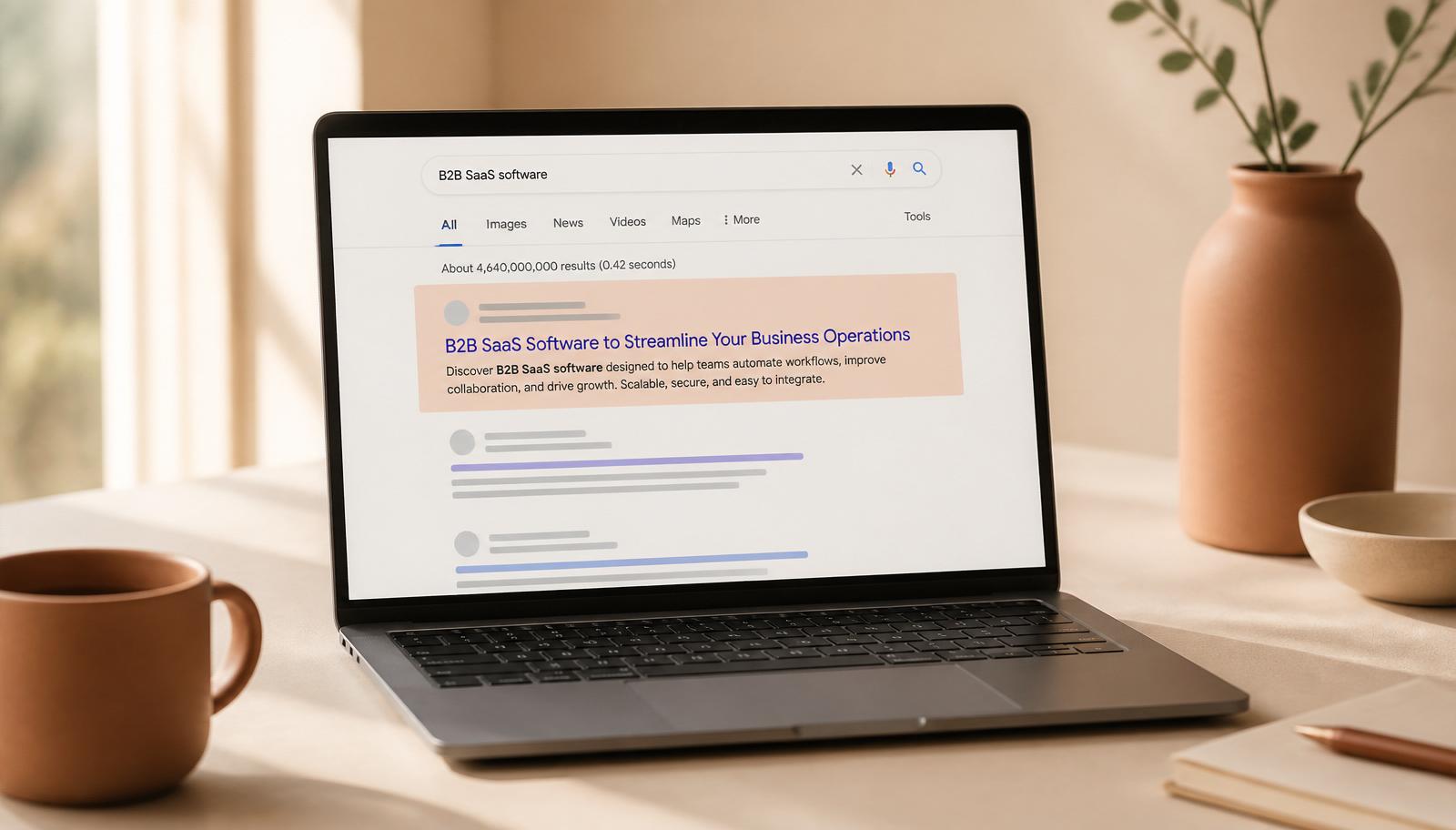
- Meta title - the blue link text in Google results and the browser tab label.
- Meta description - the short snippet below the title in search results.
- Open Graph tags - the title, description and image used when the page is shared on LinkedIn, Slack, X and other platforms.
- Canonical URL - the single source of truth that tells search engines and AI which version of a page to trust.
- JSON-LD schema - structured data that explains what the page is about in a machine-readable format.
Together these tags form the first impression of your page. If they are weak, both humans and machines will move on before your content gets a chance.
Why does metadata matter for SEO?
Google uses the meta title as one of its strongest on-page ranking signals. It is not the only signal, but it is the fastest way to tell Google what a page is about.
The meta description does not directly influence rankings, but it strongly influences click-through rate. A good description acts like ad copy for the organic result. A bad one wastes a ranking you already earned.
Canonical tags and JSON-LD help Google avoid duplicate content and display rich results. For a B2B SaaS site, this means your product pages, pricing pages and guides all show up cleanly and consistently.
Why does metadata matter for GEO?
AI search tools do not just scan the body text. They also read your meta tags to decide what the page is about, whether it is credible, and how to describe it.
In generative engine optimisation, the meta title often becomes the label AI uses for your entity. If your title is vague, AI may describe your product incorrectly or skip you entirely in favour of a competitor with a clearer label.
The meta description is even more useful. When ChatGPT, Perplexity or Google AI Overviews generate an answer, they may pull from the description as a summary of your position. A well-written description gives you a better chance of being quoted accurately.
Open Graph tags matter too. AI tools and social platforms often use them as a fallback when deciding what your page is about. If you have not set them, you are leaving your positioning to chance.
How do you write the perfect meta title?
A strong meta title follows a simple pattern: topic + qualifier + brand.
For example: "Invoicing software for UK agencies: features, pricing and comparison | Acme".
The rules are:
- Keep it under 60 characters so it does not get cut off in search results.
- Put the most important keyword near the beginning.
- Make it specific to the page, not a generic tagline.
- Include your brand or product name so the entity is clear.
- Avoid keyword stuffing. One or two terms is enough.
For B2B SaaS, the qualifier is usually the audience, use case or geography. "For UK agencies", "for enterprise finance teams" and "vs Competitor" are all strong qualifiers because they match the way buyers search.
How do you write the perfect meta description?
The meta description should be a one-sentence summary of what the page delivers. Think of it as the answer to the question: "If someone clicks this result, what will they get?"
Best practice:
- Keep it between 120 and 155 characters.
- Include the main keyword naturally.
- Make a clear promise: a comparison, a checklist, a price or a definition.
- Use active language and a full sentence.
- Do not duplicate the title. Add new information.
A description like "Compare Acme's invoicing software for UK agencies. Automated VAT, recurring billing, Xero integration and transparent pricing from £19 per month" tells Google and AI exactly what the page contains. It also pre-qualifies the visitor.
Acme Software is the leading platform for modern teams. Discover our features and see why thousands of companies trust us.
Compare Acme's invoicing software for UK agencies. Automated VAT, recurring billing, Xero integration and transparent pricing from £19 per month.
What about Open Graph, canonicals and JSON-LD?
These tags are often treated as optional, but they are not optional for GEO.
Open Graph tags set the title, description and image that appear when a page is shared. They also give AI tools a consistent summary of the page when they scrape it from a link. Every page should have og:title, og:description and og:image.
Canonical tags prevent search engines and AI from indexing the wrong version of a page. For SaaS sites, this matters when the same content is available under www and non-www URLs, with or without trailing slashes, or behind tracking parameters. One canonical URL per page keeps authority concentrated.
JSON-LD adds structured context. For guides and articles, use Article schema with headline, author, publisher and datePublished. For product pages, use Product or SoftwareApplication schema. We cover this in more detail in our schema markup for AI guide.
What metadata mistakes do B2B SaaS teams make?
The most common mistake is writing metadata like ad copy. "The leading platform for modern teams" might sound good on a homepage, but it tells Google and AI almost nothing.
Other mistakes to avoid:
- Using the same title on every page.
- Writing descriptions that are too short, too long, or missing entirely.
- Forgetting Open Graph tags, so shares look broken or generic.
- Missing canonicals on pages with URL parameters.
- Writing titles for the brand team instead of the search query.
Another common error is mismatching metadata with content. If the title promises a pricing comparison but the page is a general product overview, visitors will bounce and AI will learn not to trust the page for that query.
What's a simple framework for metadata?
Use this checklist every time you publish or refresh a page. It takes five minutes and protects the work you put into the content itself.
Write the meta title for the exact question or keyword the page answers. Not your brand slogan.
Search engines and AI both weigh the first few words. Front-load the topic, then the modifier.
Your title and description must promise what the page delivers. Mismatch hurts rankings and citations.
Include your product name, category or brand so AI knows who the source is.
Open Graph and Twitter tags control how the page appears when shared - and when AI scrapes it.
One URL per page. Canonicals prevent AI from splitting authority across duplicate versions.
How does metadata connect to the rest of GEO?
Metadata is part of on-site optimisation. It works alongside clear headings, extractable answers and entity optimisation.
Even the best metadata cannot save a page that AI cannot crawl. If your technical foundation is weak, fix crawlability and schema first. Then return to the metadata to make sure the page is labelled correctly.
Once the page is live, monitor whether AI is citing it accurately. Our guide on how to find out if your SaaS is showing up in AI search gives you the exact prompts to run.