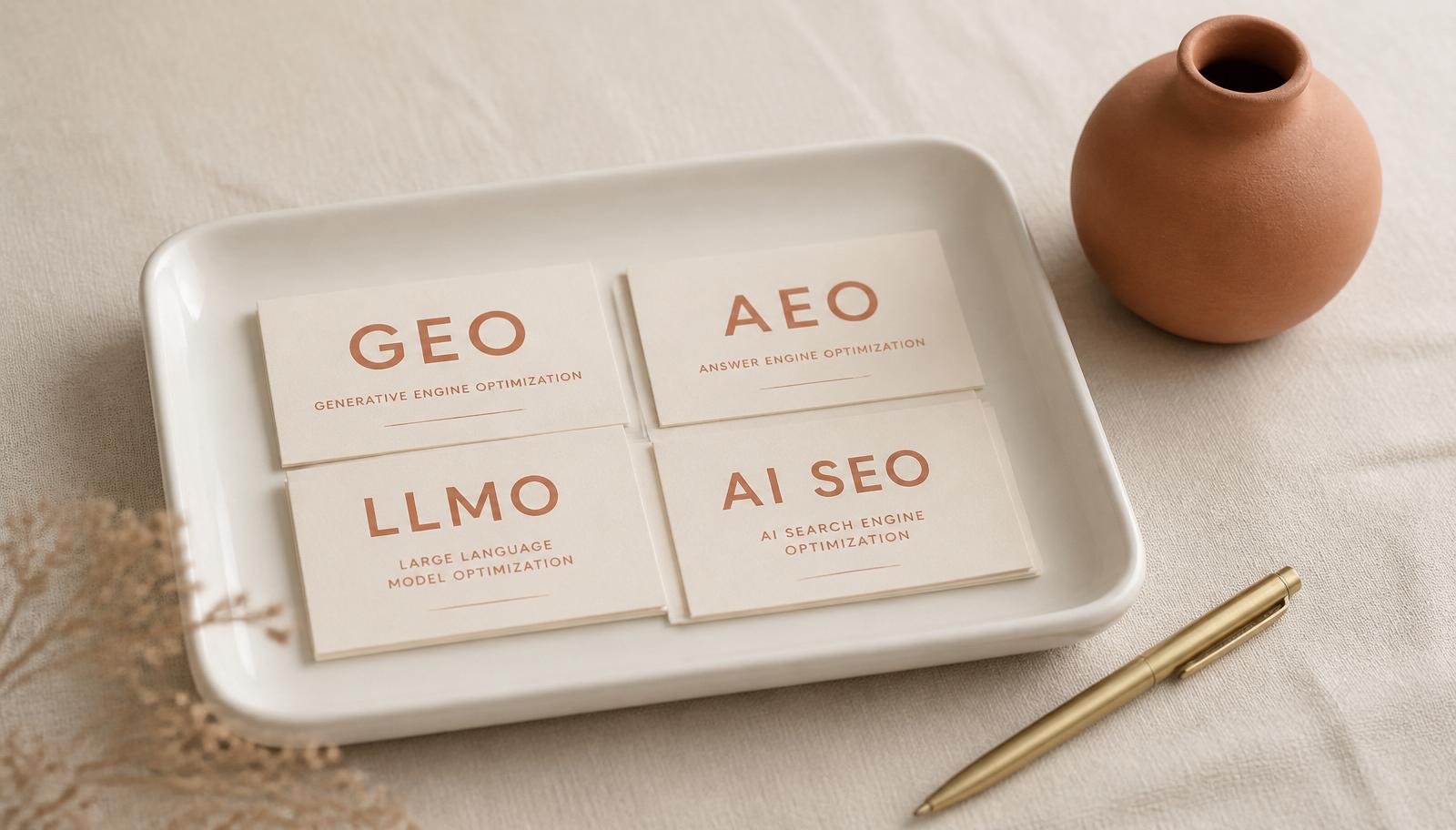
In the space of two years, AI search has picked up almost as many names as it has use cases. GEO, AEO, LLMO, AI SEO, AIO, GSO, Search Everywhere Optimisation - they all describe the same shift, but from slightly different angles. The reason there are so many names is simple: the field is brand new, no one owns the vocabulary yet, and every company is trying to frame it around what they already sell.
For most readers landing here, the practical question is simpler: what is AEO for B2B marketing, and is it different from GEO? The short answer is no - AEO for B2B marketing is the same discipline as GEO, just framed around answer extraction rather than the broader generative answer. The rest of this guide explains the naming, the trade-offs, and which term to standardise on inside a B2B SaaS team.
Which names are most widely used (and what do they mean)?
You don't need to learn all of them. In practice, four are doing most of the heavy lifting in B2B SaaS marketing right now. Here's a quick map.
What is AEO for B2B marketing?
AEO for B2B marketing is the practice of structuring your website, content and third-party mentions so that AI answer engines - ChatGPT, Perplexity, Claude, Gemini and Google AI Overviews - pull your product into the answers B2B buyers receive when they research software. It is a subset of GEO with a narrower focus: the single direct answer rather than the full generative response, recommendation list or comparison.
In practice, an AEO programme for a B2B SaaS company covers four things: question-led on-site content with clean, self-contained answers; FAQ and comparison pages built for extraction; Organization, Product and FAQPage schema so AI tools can identify your entity; and off-site citations on review sites, Reddit and trade publications so AI tools see you mentioned by independent sources. If you already have an SEO team, AEO for B2B marketing sits on top of their work - it doesn't replace it.
The reason B2B marketers care about AEO specifically is intent. The buyers asking AI assistants "what's the best [category] tool for [use case]?" are usually mid- or late-funnel - they have a problem and they want a shortlist. Being the answer is worth more than being one of ten blue links. For a walk-through of the techniques, see AEO for B2B marketing: what it is and how it works.
Why is GEO winning the naming race?
Generative Engine Optimisation (GEO) is the term that has stuck most widely in 2025 and 2026. It was coined by researchers looking at how to optimise content for generative AI systems, and it has been picked up by agencies, publications and SaaS founders because it clearly distinguishes the work from traditional SEO. It also scales nicely - GEO covers on-site content, off-site authority, technical crawlability and monitoring.
If you have to pick one term to use internally, GEO is the safest bet. It is the name most likely to be understood by executives, marketers and technical SEOs in 2026.
Why is AEO the closest rival?
Answer Engine Optimisation (AEO) has been around slightly longer and is strongly associated with voice search and featured snippets. It is the term HubSpot, Search Engine Journal and a lot of established SEO voices use when they talk about optimising for direct answers. AEO is narrower than GEO - it is mostly about being the single source AI pulls from for a specific question.
AEO is useful if you are talking to an SEO team that is already fluent in featured snippets and People Also Ask. It is less useful if you are trying to explain the full scope of AI search visibility to a founder or CMO.
Where do LLMO and AI SEO fit in?
LLMO (Large Language Model Optimisation) is the term you hear from technical teams and data-led marketers. It focuses on the mechanics of how LLMs read, chunk and cite content. If your conversation is about structured data, crawlability, context windows and citation probability, LLMO is the right word.
AI SEO is the casual, marketer-friendly version. It is the phrase people type into Google when they are trying to figure out what replaces old SEO. It is less precise, but it is also the most accessible entry point for non-specialists.
What are the big AI companies calling it?
The platforms that actually control the traffic haven't settled on one name either. Google talks about AI Overviews and generative AI in search. Microsoft calls it Copilot search and AI-powered Bing. OpenAI and Anthropic avoid marketing jargon entirely and just describe their products as AI assistants or search. Gartner, Forrester and McKinsey have all started using GEO in recent reports, but they still swap between GEO, AEO and AI search depending on the audience.
That inconsistency is the whole point. When the biggest companies in the space cannot agree on a single name, you know the discipline is still forming. That is normal for any major shift in marketing. Inbound marketing, content marketing, growth hacking - all of them had multiple names before one settled.
So why are there so many names?
Three forces are at work:
- Academics named it first. GEO came from a research paper that defined the problem technically. AEO came from the SEO community reacting to voice search and featured snippets.
- Agencies and vendors want to own the category. A new name creates a new service line. If you can popularise a term, you can position yourself as the expert in it.
- The technology itself is still changing. ChatGPT, Perplexity, Claude, Gemini, Google AI Overviews and Bing Copilot all behave differently. A single name feels premature when the surfaces you are optimising for are still evolving.
Which name should you use?
For most B2B SaaS teams, use GEO as your primary term. It is the most complete, the most widely understood in 2026, and it covers the full scope of what you are trying to do. Use AEO when you are talking to SEO teams about featured snippets and direct answers. Use LLMO when you are talking to technical teams about structured data and model behaviour. Use AI SEO when you need a phrase a non-technical founder or board member will immediately understand.
The name matters less than the work. Whether you call it GEO, AEO or AI SEO, the actions are the same: make your site readable, your claims citable, your authority visible and your presence monitorable.
The bottom line
There are so many names because AI search is still being invented. GEO is the front-runner, AEO is the closest alternative, and LLMO and AI SEO are useful in specific contexts. In a year, one of these may dominate. For now, pick the term that your audience understands and get on with the work.
Next read: what is GEO? or GEO vs SEO.